Wireless bed alarms are fall-alert devices that use sensors to detect when a person exits or falls from a bed and instantly notify caregivers. These systems benefit home users, aged care facilities, and participants in NDIS (National Disability Insurance Scheme) support programs by providing timely alerts to prevent unattended falls. In Australia—where falls are a leading cause of injury among seniors[1]—wireless bed alarms have become an important tool in fall prevention plans. Safe-Life (a supplier of assistive technology) offers such alarms alongside other brands like Cura1, helping Australians improve safety without using restrictive measures.
What are Wireless Bed Alarms?
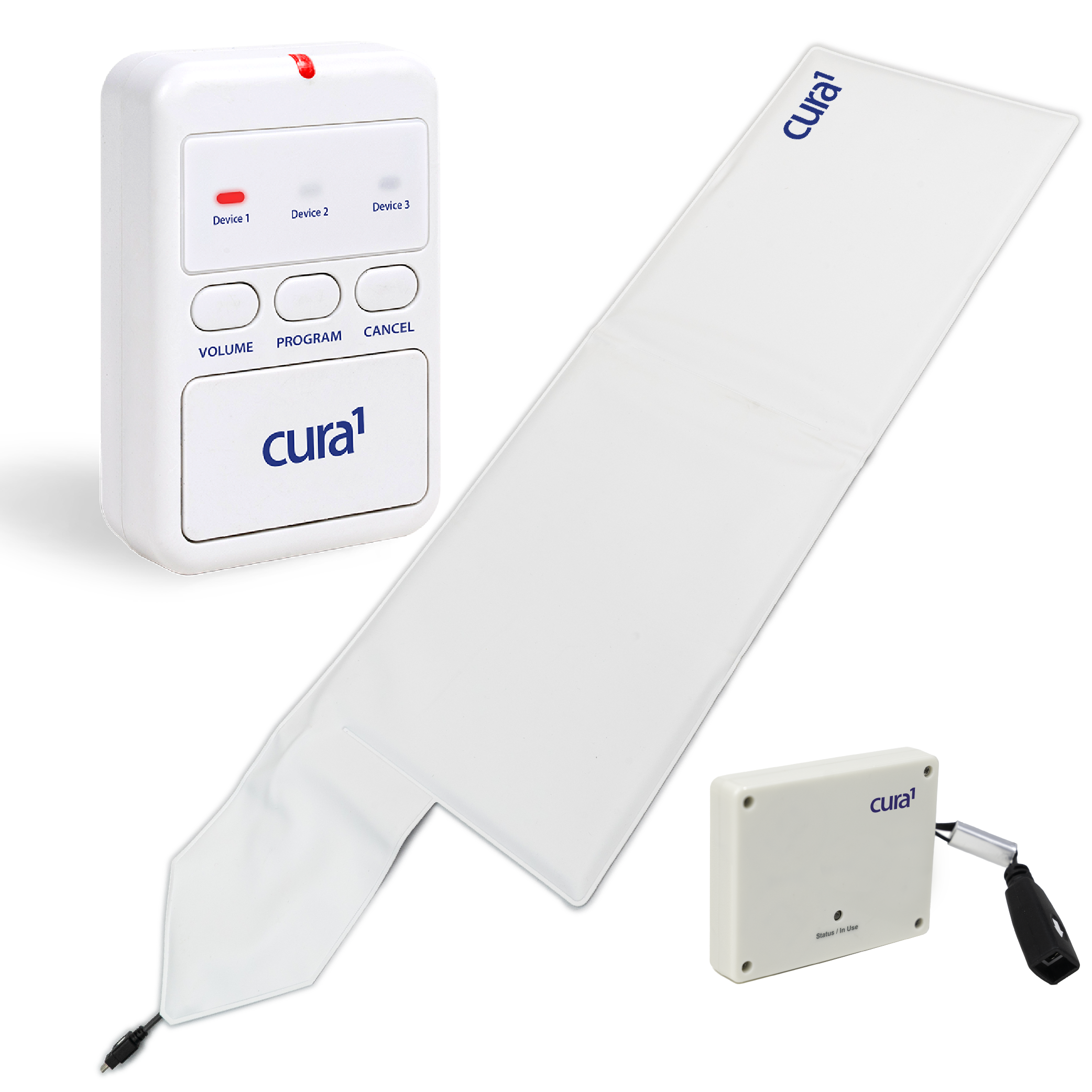
Wireless bed alarms are sensor-based alert systems designed to detect bed exit or motion and send a signal to caregivers. They typically consist of a sensor (e.g. a pressure pad or motion detector) placed on the bed or nearby, and a wireless transmitter/receiver that triggers an alarm or pager. For example, a pressure-sensitive pad under the mattress can sense weight shifts and transmit an alert when a person tries to get up[2]. Unlike older corded alarms, wireless systems transmit signals via radio frequency (often around 433 MHz) to a portable pager or central monitor, eliminating trip hazards and allowing more flexibility in placement. In practice, these alarms are used in private homes, nursing homes, and hospitals to reduce response time when an at-risk senior attempts to stand unassisted.
In the Australian context, wireless bed alarms align with a shift toward least-restrictive fall prevention. They do not physically restrain the person; instead, they act as an early-warning system so carers can intervene promptly. (It’s important to note that such alarms are not a substitute for attentive care, but rather an extra layer of safety[3].) Safe-Life is an Australian provider of these systems and distributes both its own Safe-Life branded kits and Cura1 branded devices, ensuring compatibility with local care standards and needs.
Why does this matter for Australians?
Falls are a major health concern for older Australians. Around one in four Australians over 65 experiences at least one fall each year, and falls are the leading cause of injury-related hospital admissions in this age group[1]. As Australia’s population ages, the impact of falls is growing – the Australian and New Zealand Falls Prevention Society notes roughly 30% of over-65s fall annually[4], contributing to significant healthcare costs and loss of independence. Many falls occur when seniors get up from bed without assistance, especially at night or in unfamiliar environments. For family caregivers and aged care staff, unobserved night-time movements can result in serious injuries from falls.
Wireless bed exit alarms and related fall prevention devices directly address this issue by providing immediate alerts. By catching a bed exit in progress, these alarms enable carers to reach the person before they collapse or wander, potentially averting injuries like hip fractures. This is especially important in aged care homes and hospitals where one staff member may monitor multiple residents. In home settings, an alarm gives peace of mind to families that they will be woken or alerted if their loved one tries to get up alone[5]. Overall, for Australians – whether seniors living at home, NDIS participants with disabilities, or residents in aged care – wireless alarms for falls offer a proactive approach to safety that supports independent living while reducing the risk of unnoticed accidents.
What solutions or strategies are commonly used?
Falls prevention involves a combination of technology and environmental strategies. Wireless bed alarms are one key tool, but they are often used alongside other solutions to cover different scenarios. Common fall prevention devices and strategies include:
- Bed and Chair Exit Alarms: These use pressure sensors on beds or chairs to detect when a person stands up. For instance, a thin bed sensor pad on the mattress or an under-mattress pad triggers an alert when weight is removed. Safe-Life offers a Safe-Life bed pad alarm kit (a pressure-pad and monitor system) as well as a Safe-Life under-mattress bed sensor kit that can detect exits without placing anything on top of the mattress. Similarly, Cura1’s Cura1 wireless bed pad kit and Cura1 under-mattress sensor kit provide cordless bed exit monitoring for home or facility use. For chairs, there are pressure pads that alert when a person leaves the seat, like the Safe-Life chair pad alarm kit (for armchairs or wheelchairs) and a Cura1 wireless chair pad kit for similar purposes.
- Passive Infrared (PIR) Motion Sensors: PIR sensors act as invisible beams or motion detectors by a bedside or doorway. They trigger when a person’s movement is detected, without any pad or wearables. For example, a device like Safe-Life’s dual bed exit PIR sensor beam projects a low-intensity infrared beam alongside the bed; if the person attempts to get up and breaks the beam, an alert is sent. These non-contact bed exit alert systems are useful for individuals who won’t tolerate sensor pads or when you want coverage of a broader area (such as detecting someone walking past a doorway). Cura1 also offers PIR solutions (e.g. the Cura1 “iBeam” curtain sensor) for wireless monitoring. PIR sensors are commonly used in homes and aged care settings to detect motion and can integrate with nurse call systems[6].
- Floor Sensor Mats: These are pressure mats placed on the floor next to a bed or doorway. When stepped on, they send an alarm. Floor mats can be corded or wireless; wireless versions include a transmitter in the mat. They are ideal for detecting a person’s first footstep off the bed, especially if they manage to get up without triggering a bed pad. Safe-Life and Cura1 provide both wired and wireless floor mats as part of their falls prevention range[7]. For instance, a cordless floor mat placed at the bedside will alert carers as soon as weight is applied to it.
- Crash Mats (Safety Cushions): A different strategy is using a bedside crash mat, which is a thick foam mat placed on the floor to cushion the impact if someone falls out of bed. Crash mats don’t alert caregivers on their own, but they reduce injury severity. Some modern crash mats, however, come with built-in sensors or paired transmitters to act as both a cushion and an alarm. For example, the Cura1 foldable crash mat can be part of a wireless alarm system: a Cura1 wireless crash mat kit includes a pressure-sensitive mat, a wireless transmitter, and a pager to notify staff if a person steps or falls onto the mat.
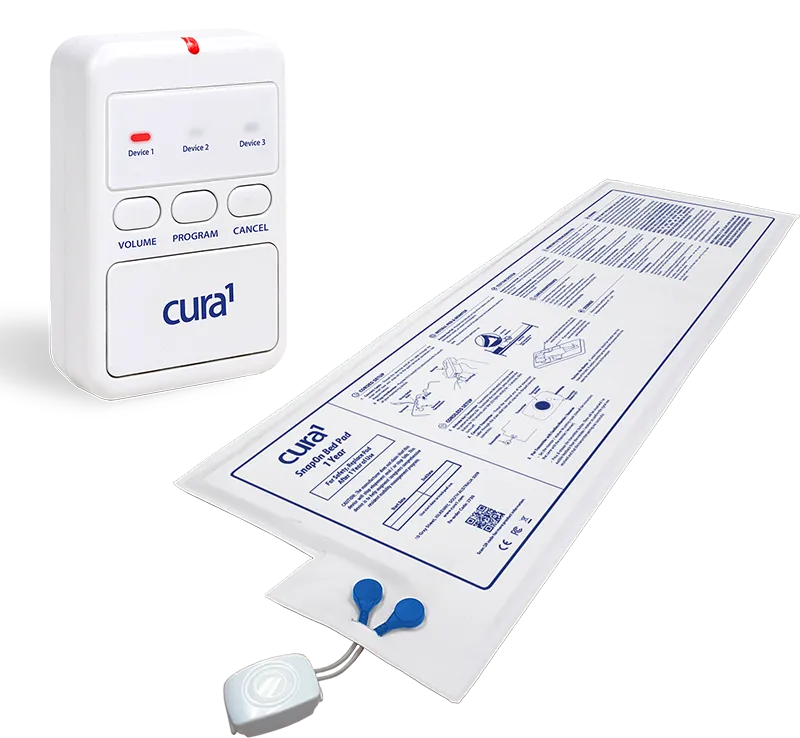
Each of these solutions addresses falls in a slightly different way. Often, they are used in combination – for example, a bed alarm pad might be used at night, and a chair alarm pad used during daytime naps, while a crash mat or PIR sensor adds backup protection. By deploying multiple strategies, caregivers can cover various scenarios (bed, chair, wandering near exits) as part of a comprehensive falls prevention plan.
How do these solutions work?
The operation of wireless bed and chair alarms, PIR sensors, and similar devices follows a common trigger-and-alert process:
- Sensor Triggered: The system’s sensor detects a key event. This could be pressure change (e.g. a person lifting their weight off a bed pad or stepping on a floor mat) or motion (breaking a PIR beam). For example, when someone starts to get out of bed, a pressure pad senses the weight shift immediately[8].
- Wireless Signal Transmission: The sensor, via a connected transmitter, sends a wireless signal (radio frequency) to a receiver unit. Most systems use a short-range RF signal (around 433 MHz) with an effective range of roughly 30–50 meters indoors[9]. No Wi-Fi or internet is needed – the communication is direct and typically secure.
- Alarm/Notification: A receiver device (which can be a pager, alarm monitor, or nurse call receiver) gets the signal and generates an alert. The alert may be an audible alarm, vibration, flashing lights, or a combination. For instance, a caregiver’s pager might vibrate and beep, showing which sensor triggered (some pagers can monitor multiple zones or pads simultaneously)[10]. In a nurse call setup, the signal might activate an over-bed light or nurse station panel.
- Caregiver Response: Upon notification, a caregiver or nurse checks on the individual and assists them, thereby preventing a potential fall or addressing it immediately if a fall occurred. The caregiver can then reset the alarm (e.g. pressing a cancel button on the pager or monitor) to ready the system for the next use[11].
- Limitations & Considerations: These systems are only effective if someone responds promptly. Delayed response can limit the benefit, so alarms are typically loud enough or persistent until acknowledged. Proper placement of sensors is also important to avoid false alarms or missed events (for example, a bed pad should be positioned under the shoulders/hip area so it triggers as soon as the person sits up). Users and staff require brief training to test and maintain the devices (like checking batteries regularly). Finally, while alarms help prevent unattended falls, they do not physically restrain or stop a determined individual – they are a preventive alert, not a physical barrier, so they should be combined with adequate supervision[3].
By following this chain of detection, transmission, and alert, wireless fall alarms ensure that a potentially vulnerable person is not on their own for long after leaving their bed or chair. This prompt communication is critical in preventing the so-called “long lie” after a fall, which can lead to complications if a person remains on the floor too long[12].
Who benefits from these solutions?
Wireless bed alarms and related fall prevention devices provide benefits across multiple groups in the Australian care context:
- Older Adults at Risk of Falls: Seniors who live alone or in aged care can maintain a level of independence knowing an alarm will call for help if they get up unsafely. It reduces fear of falling at night, since they know someone will be alerted if they need assistance.
- Family Caregivers in Home Settings: Relatives caring for an elderly family member at home gain peace of mind and the ability to sleep or tend to other tasks. A bed alarm will wake them if their loved one tries to get up, acting as a “second set of eyes”[5] and preventing constant vigil through the night.
- Aged Care Facility Staff: In residential aged care or hospitals, nurses and care staff can monitor multiple residents more effectively. Alarms (whether pads, PIRs, or floor mats) alert staff to a specific room, enabling timely intervention even during overnight shifts when staffing may be lower. This supports better compliance with falls prevention protocols and reduces injuries in care facilities.
- NDIS Participants: Individuals with disabilities or younger people (under 65) with conditions that raise fall risk (e.g. neurological conditions, balance disorders) also benefit. Through NDIS funding, many can obtain these assistive devices to improve safety in their homes or Supported Independent Living (SIL) arrangements. For example, an NDIS participant with impaired mobility can use a bed exit sensor so that support workers are notified when they need help moving.
- Healthcare and Disability Support Providers: Organisations providing home care, group homes, or specialist disability accommodation (SDA) find these alarms useful for managing client safety. It allows support workers to be immediately notified of falls or attempted unsupervised transfers, thereby improving duty of care. Providers can also document alarm usage as part of falls prevention planning, which is often required under care standards.
In summary, senior Australians, their carers, and support services all benefit from the added safety net these alarms provide. By preventing undetected falls, they help avoid injury, emergency hospitalizations, and the loss of confidence that often follows a fall[13].
Safe-Life vs Cura1 Bed-Exit Alarm Systems (Comparison)
Safe-Life (as a brand and retailer) and Cura1 (a popular falls prevention brand) both offer bed-exit alarm solutions in Australia. The table below compares their key features and suitability:
| Feature | Safe-Life Bed-Exit Systems | Cura1 Bed-Exit Systems |
| Sensor Type Options | Pressure sensor pads for beds and chairs (includes on-mattress pads and under-mattress pads for pressure-free sensing). Also offers PIR motion sensors (e.g. dual beam) for non-contact monitoring. | Pressure sensor pads for beds and chairs (including standard, pre-alert pads with early detection). Also offers PIR curtain beams (e.g. iBeam) for motion-based alerts. |
| Wireless Range | ~150 m typical indoors with UHF systems for larger homes or facilities[14]. Wired options available for direct nurse-call integration (no wireless range limit). | ~50 m typical wireless range (433 MHz) for most cordless Cura1 kits[9]. Uses standard short-range RF suitable for home or ward environments. Also offers hardwired systems and nurse-call plug-in transmitters for facility use. |
| Use Case & Focus | Flexible use in home care or facilities: Safe-Life’s own kits often cater to home users (easy DIY setup) and can be adapted to facility nurse-call systems (especially the hardwired kits). Emphasizes user-friendly installation and dual-purpose sensors (interchangeable between bed/chair). | Widely used in aged care facilities and hospitals: Cura1 is known for hospital-grade systems with features like pager integration and “heartbeat” sensor monitoring[15][16]. Also provides home-use packages (e.g. wireless kits with pager) for family carers. The brand focus is on reliability and compatibility with institutional needs. |
| NDIS-Friendliness | Safe-Life is an NDIS-registered provider (ID 4050109546[17]). Its products qualify as low-cost assistive technology, usually <$1500, meaning NDIS participants can purchase them easily (often without special assessment). Safe-Life’s long experience (30+ years) in Australia’s healthcare market ensures their systems meet local safety standards. | Cura1 products are NDIS-eligible and commonly funded under NDIS plans via providers like Safe-Life. They are used in SDA housing and SIL environments to enhance participant safety. Cura1 devices comply with Australian safety requirements (e.g. electrical and aged-care standards). Support and training are available through local distributors (like Safe-Life), making them a trusted choice in clinical settings. |
Table: Comparison of Safe-Life and Cura1 bed-exit alarm systems in Australia.
Both brands ultimately share the goal of fall prevention, offering similar core functionality. Safe-Life’s own systems provide a local Australian take (with some unique kit configurations and direct NDIS provider support), while Cura1’s systems bring a broad range of proven products often found in healthcare settings. In practice, many facilities use a mix of both – for example, a Safe-Life under-mattress pad in one room and a Cura1 crash mat system in another – since Safe-Life distributes Cura1 and ensures all components can work together seamlessly.
Australian Regulatory and Compliance Notes (NDIS, SDA, SIL)
When implementing wireless bed alarms and related fall prevention devices in Australia, it’s important to consider funding and regulatory compliance aspects:
- NDIS Compliance: Most bed exit alarms and fall sensors are classified as Assistive Technology (AT) for safety. Under the NDIS, these are typically low-cost, low-risk AT (each item under $1500) which means participants can buy them using their funding without a lengthy approval process. Safe-Life, as an NDIS registered provider, can supply devices like bed alarms directly to participants and claim through their NDIS plans. The devices themselves do not require specific certification by NDIS, but they should fit the participant’s assessed needs (often documented in their care plan). All Safe-Life and Cura1 products mentioned are NDIS-friendly – they are commonly recommended by occupational therapists and included in NDIS plans to mitigate fall risks at home.
- Aged Care Standards: In residential aged care, the use of sensor alarms aligns with the Aged Care Quality Standards’ focus on falls prevention and restraint minimization. Bed and chair alarms are considered least restrictive measures (they don’t confine movement, only alert staff), which is important given regulations limiting restraint use. Providers must still obtain consent for any monitoring device and ensure its use is part of a broader falls management plan. The Aged Care Quality and Safety Commission has highlighted falls prevention as “everyone’s business,” noting that multiple strategies are needed[19]. Sensor devices can be one such strategy, helping providers meet their duty to safeguard residents. There are no specific Australian Standards mandating the use of bed alarms, but devices should be electrically safe (medical device standards) and used according to manufacturer instructions. Cura1 and Safe-Life devices are designed to meet relevant safety requirements and are used widely in compliance with care guidelines.
- Specialist Disability Accommodation (SDA) & SIL: In SDA homes (housing designed for NDIS participants with high support needs) and SIL arrangements, emergency call systems and fall prevention measures are often built into the environment. While SDA design standards require features like emergency response call buttons, bed exit alarms can complement these systems. They provide a personal-level alert that a support worker can carry (pager or phone integration), which is especially useful overnight. There is recognition that technology like PIR sensors or bed alarms can reduce the need for intrusive overnight checks, thereby promoting privacy and independence for residents. Service providers implementing these devices in group homes should have policies on their use, ensuring residents consent and understand the alarms. From a compliance perspective, using alarms to prevent falls supports the NDIS practice standards in ensuring participant safety in assistance with daily living. In summary, these devices are allowed and encouraged in supported living contexts as long as they are part of a documented support plan and regularly reviewed for effectiveness.
Overall, wireless fall alarm systems are seen as a positive, proactive safety measure under Australian care standards. They enable providers and families to meet their legal and ethical obligations to keep people safe, without resorting to restraints. As with any care strategy, proper training in device use and response protocols is key. Both Safe-Life and Cura1 provide user guides and local support to ensure organisations can integrate the alarms in compliance with relevant guidelines.
Summary
Falls remain a significant challenge for Australia’s ageing population, but technology like wireless bed alarms, chair sensors, PIR beams, and crash mats are making a tangible difference in prevention. In this post, we defined what wireless bed exit alarms are and how they work: by detecting movement or pressure changes and sending immediate alerts to caregivers[2]. We highlighted why these devices matter in Australia, citing the high incidence of falls among older adults[1] and the need for early intervention. We also reviewed common solutions – from pressure pad alarms to sensor mats – and explained their operation step-by-step. Importantly, we identified who benefits from these tools: seniors, carers, aged care staff, and NDIS participants all gain added safety and peace of mind[5].
A comparison of Safe-Life and Cura1 systems showed that both offer effective fall prevention alarms with slight differences in features and use cases. Both brands’ solutions are NDIS-eligible and compliant with Australian care standards, meaning consumers and facilities can adopt them with confidence. When deploying these devices, considering regulatory aspects (such as NDIS funding rules and aged care guidelines) ensures they are used appropriately and to their full benefit.
In conclusion, wireless bed alarms and related fall prevention devices are a practical, evidence-backed strategy to reduce falls and injuries among older or disabled individuals. They support a safer environment by bridging the gap between a person’s need for autonomy and a caregiver’s need to know when help is required. Safe-Life, as an Australian provider of senior safety alarms, offers a range of these solutions (including both its own and Cura1’s products) in a neutral, accessible manner – focusing on reliability and ease of use rather than hype. By incorporating such technology into care plans, Australians can help ensure that a momentary loss of balance does not turn into a life-changing accident, making aging and disability support safer for all involved.
Sources: Recent Australian falls statistics[1][4]; Safe-Life product information and guides[9][8]; Safe-Life Motion Detection Systems article[6][5]; ANZ Falls Prevention Society data[4]; Aged Care Quality & Safety Commission guidance on falls[1]; Keystone Health fall prevention insights[3].
[1] [19] Falls Awareness month | Aged Care Quality and Safety Commission
[2] [5] [6] [7] [14] [17] Motion Detection System for Beds | Safe-Life
[3] Bed alarms and fall prevention in hospitals
https://keystonehealth.care/knowledge-centre/11650-bed-alarms-and-fall-prevention-in-hospitals
[4] [12] [13] Info about falls | Australia and New Zealand Falls Prevention Society
[8] [10] [11] Wireless Crash Mat Kit for Home Use – Complete Cura1 Cordless Safety System | Safe-Life
[9] [15] [16] Cura1 SnapOn Bed Alarm Pad kit | Safe-Life