If you’re choosing a bed alarm for a family member or a facility, it’s a fair question to ask before you buy one: do these things actually work? It’s not a question most suppliers want to answer honestly, because the research is more complicated than a product page usually lets on.
We sell bed alarms, so we have a stake in this conversation. But we’d rather give you the honest picture than a sales pitch, because a falls prevention plan built on the wrong assumptions doesn’t help anyone. Here’s what the published research actually says, where it falls short, and how bed alarms fit into a plan that works.
What the research says
The most direct evidence comes from a large hospital trial published in Annals of Internal Medicine in 2012. Researchers followed nearly 28,000 patients across 16 units in a Tennessee hospital over 18 months, training staff on some units to use bed alarms consistently while leaving others with standard access. Alarm use rose roughly 36-fold on the intervention units. The fall rate didn’t change. As one of the study’s co-authors put it at the time, if you think the alarm alone is going to solve the problem, you’re mistaken.
A 2018 Cochrane review looked at the available hospital trials on bed and chair sensor alarms and rated the evidence “very low-quality.” That’s not the same as proof they don’t work. It means the existing studies aren’t good enough to say either way with confidence.
The most recent and broadest look is a 2022 systematic review and meta-analysis in Age and Ageing, which pooled the available hospital trials on bed alarms, chair alarms and wearable sensors. It found these devices were “not associated with significant fall reductions.” The same review did find one intervention that made a measurable difference: staff and patient education programs.
A fourth review, published in the journal Healthcare in 2019, looked specifically at alarm and alert devices in long-term aged care facilities rather than hospitals, which is closer to how many of our customers actually use them. Its conclusion was blunt: alarms alone are “relatively useless” as a standalone intervention, but can play a role within a properly run, multi-part falls prevention program.
Put together, the pattern across four independent pieces of research is consistent. Bed alarms, on their own, have not been shown to reduce how often falls happen.
Why the evidence is mixed, not damning
It’s worth being precise about what this research does and doesn’t show. None of it proves bed alarms are useless or that they cause harm. What it shows is that adding an alarm, by itself, doesn’t reliably reduce fall rates in the settings that have been studied, which are almost entirely hospitals and aged care facilities.
There’s an important gap worth naming honestly: we couldn’t find a well-designed study that specifically tested bed alarms in home care settings, which is where a large share of our customers use them. The hospital and facility evidence is a reasonable starting point, but it isn’t a perfect stand-in for someone using a bed alarm to monitor a parent at home overnight, where the caregiver relationship, response time and environment are all different.
Does the type of bed alarm matter?
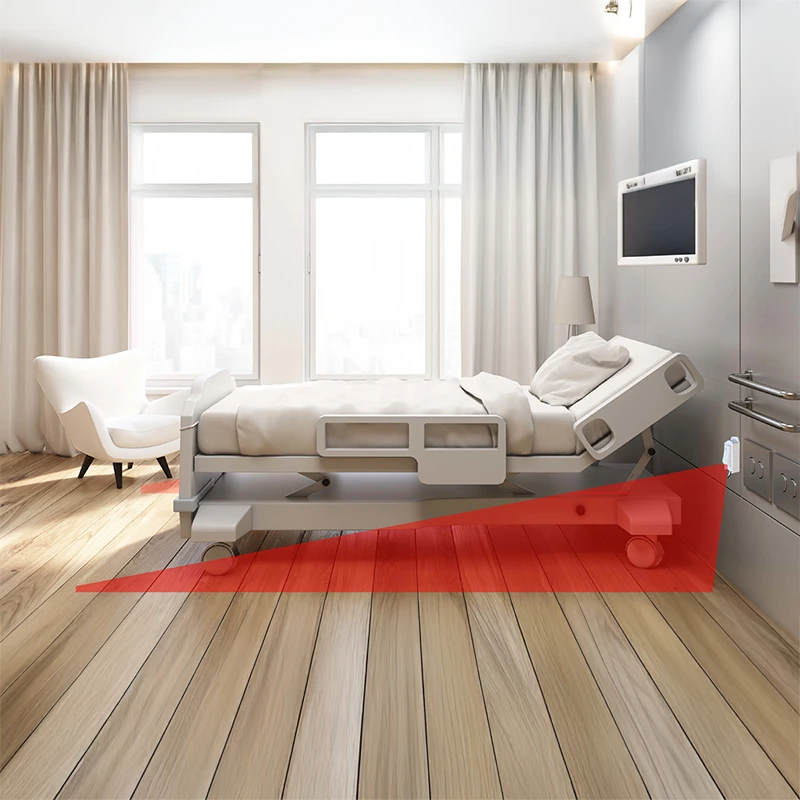
This is a question we get asked directly, and it’s a good one. Pressure-sensitive bed pads, floor mats, PIR (passive infrared) sensor beams and pads with early “pre-alert” position-change detection all work differently. Surely some of them perform better than others?
Here’s the honest answer: none of the major reviews compare these device types against each other. The Age and Ageing meta-analysis pools “chair alarms, bed alarms, wearable sensors and alert bracelets” into a single category. The Healthcare review lists pressure pads, infrared sensors, wearables, RFID tags and position-change alarms as existing technologies, but analyses them collectively rather than head-to-head. No published study has directly tested whether a pad that triggers on full bed exit performs differently from one that triggers earlier, when someone first shifts toward the edge of the bed.
That’s a real limitation in the evidence, not a reason to assume all alarm types are equivalent. It’s simply something the research hasn’t measured yet.
What about response time after a fall?
This is a distinction worth drawing out, because it’s different from whether an alarm prevents a fall from happening in the first place. Even if an alarm doesn’t stop someone from falling, could it still help by getting a caregiver there faster?
We looked for research on this specifically, and found a genuine gap. None of the reviews we could find measured how quickly staff responded after an alarm sounded, or how long someone was left on the floor afterwards (sometimes called a “long lie” in the clinical literature, generally defined as an hour or more). That matters, because long lies carry real risk on their own. One frequently cited study of people over 90 found that roughly half of those who experienced a long lie of an hour or more died within six months, even when the fall itself hadn’t caused a serious injury.
The one relevant finding we did come across is about detection timing rather than staff response: the Healthcare review notes that some alarms “have been reported to go off after the resident has left their chair or has already fallen.” That’s a real, documented limitation with certain alarm designs. It’s a different question from how fast someone responds once the alarm does go off, and from how long a person is left waiting. As far as we can tell, no published study has measured either of those things for bed alarms specifically.
We’d rather tell you that plainly than imply otherwise. If a supplier tells you their product is proven to reduce injury severity or response time, ask them for the study, because we couldn’t find one.
So why do hospitals and aged care facilities still use them?
Given the evidence above, it’s a fair question. The most consistent answer in the research and in nursing literature is that alarms are one part of a layered response system, not a standalone fix. They give staff another input alongside regular checks, risk assessments and supervision. Used that way, they may still have value even though the trials measuring alarms in isolation haven’t shown a fall-rate benefit on their own.
What actually reduces falls, according to the evidence
The most encouraging finding in the research isn’t about alarms at all. The Age and Ageing review found that staff and patient education programs were associated with a significant reduction in falls, unlike the device-based interventions. Other multi-component programs, combining risk assessment, environmental changes, mobility support and staff training, have stronger evidence behind them than any single device.
That doesn’t make bed alarms pointless. It means they work best as one component of a broader plan, not as the plan itself.
How to use a bed alarm as part of a falls prevention plan
If you’re using or considering a bed alarm, here’s how to get the most out of it based on what the evidence actually supports:
Treat it as one part of a plan, not the whole plan. Pair it with supervision, a proper falls risk assessment and clear routines for what happens when it sounds.
Make sure whoever is caring for the person understands the device and will respond promptly. An alarm that nobody hears or acts on quickly isn’t doing its job, and this is exactly the part the research hasn’t measured, so it’s worth taking seriously yourself.
Choose the right sensitivity and alarm type for the person. Overly sensitive settings lead to alarm fatigue, where frequent false alarms cause caregivers to respond more slowly or ignore them altogether. This has been documented as a real problem in nursing literature, separate from the effectiveness question above.
Reassess regularly. A person’s falls risk and mobility can change, and the right device or setting for them can change with it.
Combine it with environmental and mobility measures. Clear pathways, appropriate footwear, good lighting and mobility aids all have a role that a bed alarm can’t replace on its own.
We carry wireless, hardwired and sensor beam bed alarms built for both aged care facilities and home use, including options with earlier pre-alert detection. [Explore our range of bed alarms]
The honest bottom line
No, the published research doesn’t show that bed alarms, used on their own, reduce how often falls happen. That’s a genuinely useful thing to know before you buy one, and it doesn’t mean bed alarms have no place in a falls prevention plan. It means they work best alongside supervision, staff or family training, and the other measures the evidence actually does support, rather than as a device you can install and rely on by itself.
References
Shorr, R.I., Chandler, A.M., Mion, L.C., et al. (2012). Effects of an Intervention to Increase Bed Alarm Use to Prevent Falls in Hospitalized Patients: A Cluster Randomized Trial. Annals of Internal Medicine, 157(10), 692–699. https://www.acpjournals.org/doi/10.7326/0003-4819-157-10-201211200-00005
Cameron, I.D., Dyer, S.M., Panagoda, C.E., Murray, G.R., Hill, K.D., Cumming, R.G., Kerse, N. (2018). Interventions for preventing falls in older people in care facilities and hospitals. Cochrane Database of Systematic Reviews, Issue 9, Art. No. CD005465. https://www.cochrane.org/evidence/CD005465_interventions-preventing-falls-older-people-care-facilities-and-hospitals
Morris, M.E., Webster, K., Jones, C., et al. (2022). Interventions to reduce falls in hospitals: a systematic review and meta-analysis. Age and Ageing, 51(5), afac077. https://academic.oup.com/ageing/article/51/5/afac077/6581612
Mileski, M., Brooks, M., Topinka, J.B., Hamilton, G., Land, C., Mitchell, T., Mosley, B., McClay, R. (2019). Alarming and/or Alerting Device Effectiveness in Reducing Falls in Long-Term Care (LTC) Facilities? A Systematic Review. Healthcare, 7(1), 51. https://www.mdpi.com/2227-9032/7/1/51
Long Lie. Physiopedia. https://www.physio-pedia.com/Long_Lie