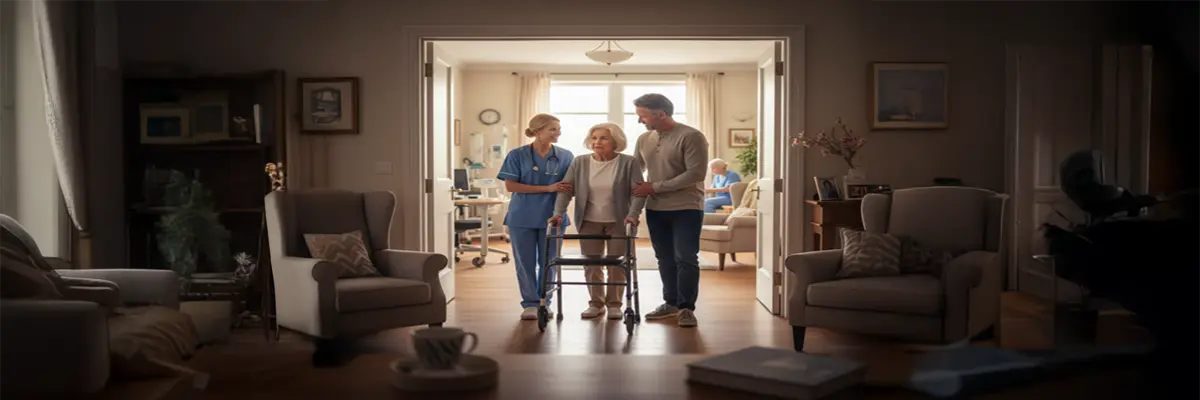
Berwick House, an SRS facility with independent NDIS provider capability in Hallam, Melbourne, needed to replace an ageing hard wired call system that had become unreliable, costly to maintain, and poorly suited to current resident needs. Safe-Life Australia provided a wireless nurse call solution that improved alert reliability, reduced maintenance demands, and gave staff more flexible call visibility across the site.
What challenge needed solving?
Berwick House supports 27 residents with mixed support needs and operates with 24/7 staffing. The building was constructed before the 1970s, and the existing hard wired nurse call system had been in place for more than 30 years.
The old system had become a practical and operational risk. Call buttons were sticking or failing, the central panel was unreliable, and alerts were only visible at a single fixed point. That meant staff away from the station could miss calls. Even minor repairs could require rewiring, which added cost and disruption in an older building.
The system also lacked reporting capability. Management could not easily review response times, call frequency, or battery-related status because that information simply was not available. Over time, this affected resident confidence and made it harder to demonstrate timely response processes.
Why was Safe-Life selected?
Berwick House selected a Safe-Life wireless solution for several practical reasons:
- It removed the need to replace ageing cabling infrastructure
- Call points could be repositioned more easily as resident needs changed
- Mobile alerting could support fixed annunciator notifications
- Waterproof options were available for wet areas
- The system offered low battery reporting and clearer device status visibility
The facility also needed a solution that could be installed with minimal disruption in an older building, where opening walls and replacing wiring would have been expensive and disruptive.
What solution was implemented?
The facility implemented a wireless nurse call setup based around the Wireless Nurse Call Self Installed platform, supported by fixed and mobile alert devices.
The rollout followed a straightforward process:
- Site assessment completed
A pre-installation review confirmed that building coverage was adequate and no radio repeater was required. - Call points selected for different environments
Standard wall-mounted call points were used in bedrooms and common areas, with waterproof call points used where required in wet areas. Safe-Life’s Tier-1 linking rules also confirm the use of the anchor text nurse call point with cancel for the relevant product. - Alert devices configured for staff visibility
One system controller with annunciator was installed, with alerts also sent to an alphanumeric mobile pager. Safe-Life’s sitemap also includes the relevant annunciator product structure. - Installation completed in one day
A total of 42 call points were installed across the facility, with testing completed the same day and minimal interruption to residents or staff routines. - Staff and resident orientation completed
Staff required only brief instruction, mainly focused on pager operation. Residents were shown how to use wall call buttons, with additional support provided where cognitive impairment was a factor.
What improvements were observed?
After 40 days, the facility reported stronger confidence in the system from owners, management, staff, and residents.
Maintenance requirements had reduced to zero during that period. Staff also saved approximately 30 minutes per shift because mobile alerts supported the fixed annunciator workflow, reducing the need to remain close to one central display point.
The result was better visibility of calls, more flexibility in how alerts were managed, and a system better suited to an active care environment in an older building.
“The Safe-Life wireless buzzer system has enhanced resident safety.”
— Keith, Manager, Berwick House
Key data table
| Feature | Detail |
| Problem Type | Ageing hard wired nurse call system with faults and missed alerts |
| Solution Type | Wireless nurse call system with fixed and mobile alerting |
| Environment | SRS / SDA facility in Hallam, Melbourne |
| Scale | 27 residents, 42 call points installed |
| Alert Devices | Annunciator plus one alphanumeric mobile pager |
| Installation Outcome | One-day install with minimal disruption |
Summary
Berwick House needed to replace an outdated hard wired call system that was no longer reliable or practical to maintain in an older Melbourne facility. Safe-Life Australia implemented a wireless nurse call solution that improved alert visibility, reduced maintenance demands, and gave the site more flexibility without requiring major building works.