AI fall prevention technology is entering a new phase. University of Arizona researchers have developed an AI-powered wearable that can detect early signs of frailty, and a rising risk of falls, days or weeks before a fall happens. Published in Nature Communications in December 2025, the soft sensor sleeve marks a shift from personal alarms that respond after a fall to technology that aims to predict and prevent one.
Quick reality check: falls are already Australia’s leading cause of injury hospitalisation and death, with people aged 65 and over accounting for 95% of all fall-related deaths in 2023–24.[1] For decades, the personal alarm industry has been built around one job: getting help to someone after they’ve gone down. This research, from the Gutruf Lab at the University of Arizona, suggests that job description is about to expand.[2] Lead author Kevin Kasper and senior author Philipp Gutruf, associate department head of biomedical engineering, put the goal simply: move elder care from reactive to preventative.
The AI Fall Prevention Technology Explained
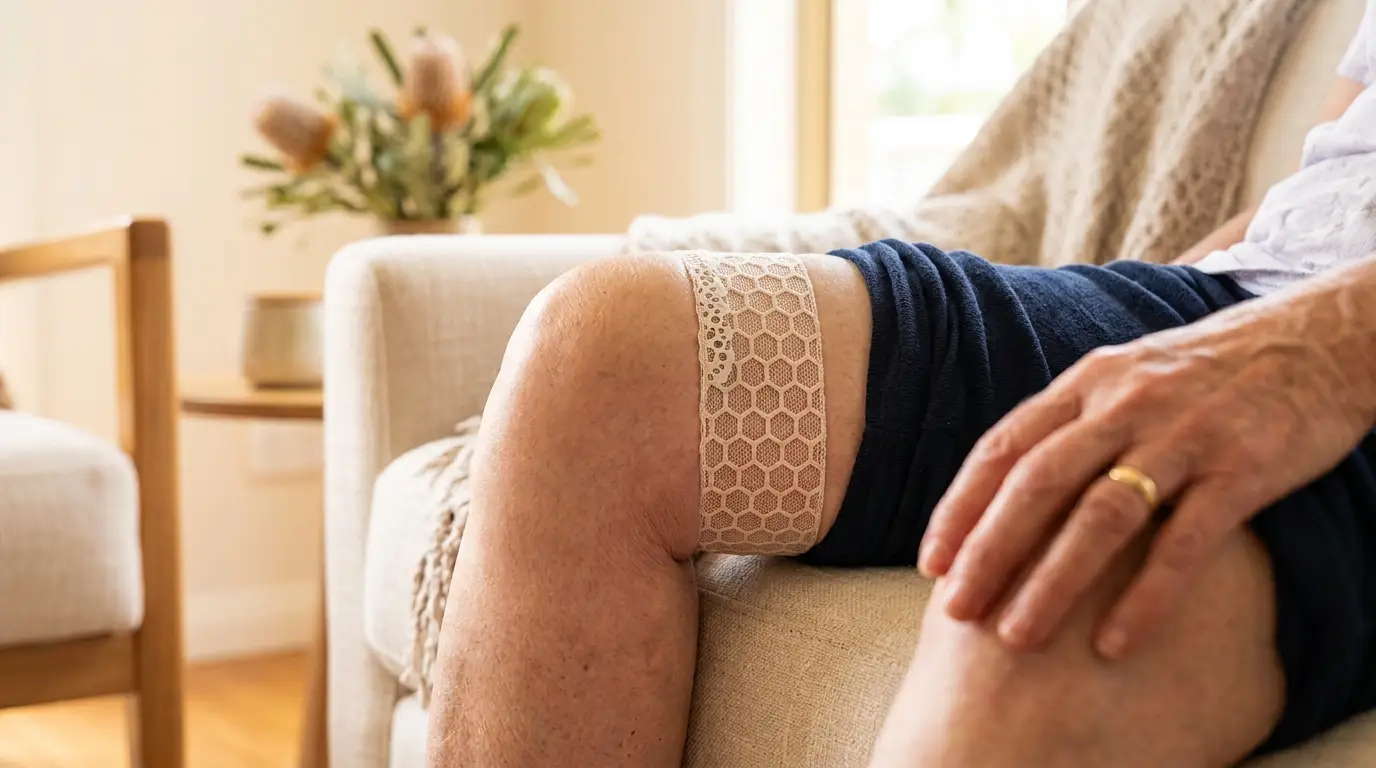
The device itself is a soft, 3D-printed mesh sleeve, about two inches wide, worn around the lower thigh. Embedded sensors continuously track leg acceleration, gait symmetry and step-to-step variability, the same subtle mechanical signatures clinicians use to assess frailty in a formal assessment, except this is happening quietly, during ordinary walking, day after day.
What makes it notable isn’t just what it measures, but where the thinking happens. Rather than streaming raw motion data to the cloud, the sleeve uses “Edge AI” to analyse the signal directly on the device and transmit only the results. According to the research team, this cuts data transmission by around 99%, extends battery life, and removes the need for a high-speed internet connection, results are sent to a smart device via Bluetooth, and the sleeve recharges wirelessly without needing to be plugged in or have its battery swapped.[2] That combination matters for real-world use, particularly for older Australians in regional or low-connectivity areas, where continuous cloud-based monitoring simply isn’t practical.
Why It Matters
Traditional personal alarms, including the pendant and wearable-watch alarms most people picture when they think of duress or medical alert devices, are activated after an event: a fall, a health emergency, a call for help. They are, by design, a response mechanism, and a very effective one.
What this research points to is different: a way to flag the warning signs before a fall happens at all. Gait changes, reduced symmetry, greater step variability, these can show up days or weeks ahead of a fall, giving clinicians, carers or family members a window to act. That might mean a referral for a strength and balance program, a medication review, or simply a conversation about extra support at home. Frailty already affects an estimated 15% of adults aged 65 and over,[2] and much of the current model only identifies it once a hospitalisation has already occurred. Catching it earlier changes the entire equation.
As Gutruf put it, “this device allows clinicians to intervene early, potentially preventing costly and dangerous outcomes.”[2]
The Bigger Picture
It’s worth being clear-eyed about where this AI fall prevention technology sits today: it’s peer-reviewed, published research, not a commercially available consumer product. But the direction of travel is unmistakable. The broader assistive technology and personal alarm industry is moving beyond “detect and respond” toward “predict and prevent,” and wearable sensors paired with on-device AI are the engine behind that shift. For older Australians and the families supporting them, the long-term promise isn’t just a faster response when something goes wrong. It’s fewer falls happening in the first place.
Where This Leaves Personal Alarms
Prediction technology, even as it matures, doesn’t replace the need for a reliable safety net. Falls will still happen, frailty assessments won’t catch every risk, and even the most attentive early-intervention plan can’t eliminate the unexpected. That’s the role personal alarms continue to play, and will keep playing even as detection technology gets smarter: a direct line to help, worn on the body, the moment it’s needed.
The most complete picture of safety for older Australians living independently likely won’t be prediction or response. It’ll be both: early warning systems that reduce how often a fall happens, backed by an alarm that’s there the moment one does. As AI fall prevention technology moves from the lab toward real-world deployment, that’s the ecosystem worth watching.
References
- Australian Institute of Health and Welfare (2024). Injury in Australia: Falls. AIHW, Australian Government. aihw.gov.au/reports/injury/falls
- Kasper, K.A., et al. (2025). Wearable AI for on-device frailty assessment. Nature Communications. doi.org/10.1038/s41467-025-67728-y; University of Arizona, Department of Biomedical Engineering (Jan 2026). AI-powered wearable device boosts proactive elderly care. https://bme.engineering.arizona.edu/news-events/ai-powered-wearable-device-boosts-proactive-elderly-care
FAQ
Is this AI fall-detection wearable available to buy?
No. As of early 2026, the device described in the University of Arizona research is a peer-reviewed research prototype, not a commercial product. It has not been released for consumer or clinical use.
How is this different from a personal alarm?
A personal alarm responds to an event, such as a fall or medical emergency, once it happens. This research aims to flag warning signs of frailty before a fall occurs, so intervention can happen earlier.
What is frailty, and why does it matter for fall risk?
Frailty is a decline in physical resilience and function that increases the risk of falls, disability and hospitalisation. It affects an estimated 15% of adults aged 65 and over and is often only identified after a fall or hospital admission.